
Bangladesh's Chief Adviser Muhammad Yunus announced that the next general election will be held in February 2026, marking the first anniversary of the 'July Uprising'.
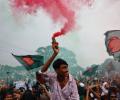
'Militants are taking over the administration. Fundamentalists have been released from jail.'
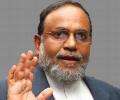
Fundamentalist Jamaat-e-Islami leader and media doyen Mir Quasem Ali was Thursday indicted by a special Bangladeshi tribunal on charges of "crimes against humanity" committed during the 1971 liberation war.

'There is no substantive basis for Bangladesh-Pakistan relations. The only real link they can have is mischief, with Pakistan's intelligence agency using Bangladesh to create trouble along our eastern borders.'
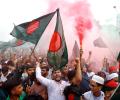
'Pakistan will also try to turn Bangladesh into a base for terrorist attacks on India.'
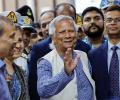
Bangladesh's interim government chief Professor Muhammad Yunus is considering resigning after political parties failed to reach a common ground, according to the National Citizen Party (NCP) chief. Yunus, appointed after a student-led uprising toppled the previous government, expressed concerns about his ability to function in the current political climate.
Bangladesh's Supreme Court on Tuesday handed down the death penalty for fundamentalist Jamaat-e-Islami leader Abdul Quader Mollah for his involvement in the 1971 war crimes, revising a special tribunal verdict which had sentenced him to life imprisonment.
Amid growing outrage here about the large-scale attack on minority Hindus and their places of worship in Bangladesh, United States National Security Advisor Jake Sullivan on Monday spoke with the interim government's Chief Adviser Muhammad Yunus and both leaders expressed commitment to protect human rights in the troubled South Asian nation.

A Bangladeshi court has sent 16 people, including veterans of the 1971 Liberation War, to jail under the Anti-Terrorism Act after a mob disrupted their public discussion.
The chief adviser's decision to stay in office came two days after he told student-led National Citizen Party (NCP) leaders that he was mulling resignation as he felt "the situation is such that he cannot work", citing difficulties in working amid the failure of political parties to find common ground for change.
Bangladesh's interim government on Sunday said it will seek Interpol's assistance in repatriating deposed prime minister Sheikh Hasina from India, and other 'fugitives', to face trial for alleged crimes against humanity.
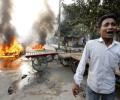
The death toll in violence across Bangladesh triggered by the execution of a top Jamaat-e-Islami leader on Saturday rose to 10, even as Islamists set afire the house of a federal minister in the country's northwest.

The move comes a few days after the Yunus-led government dropped the portrait of the country's founding father and deposed prime minister Sheikh Hasina's father Mujibur Rahman from new currency notes.

A T M Azharul Islam, a top leader of fundamentalist Jamaat-e-Islami party, was sentenced to death on Tuesday by a Bangladeshi special court for committing war crimes during the country's independence war against Pakistan.

Bangladesh is in turmoil, which is not good news for India, which shares a porous 4000 km border with it. There is a danger of fundamentalism growing there, and India has to move in to reset its ties with the new dispensation before China and Pakistan make capital out of it, alerts Ramesh Menon.
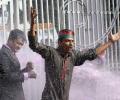
Bangladesh's decision to execute Jamaat-e-Islami chief Motiur Rahman Nizami for war crimes committed in 1971 has provoked anger across the Muslim world. Foreign Secretary S Jaishankar arrived in Dhaka hours after the execution, an important expression of India's support to Prime Minister Sheikh Hasina, explains Rajeev Sharma.

New Delhi -- which has had a disastrous neighbourhood policy that has alienated almost all the States with which it has a land or sea border -- seemed to be unwilling over the past years to even consider that its unquestioning support of Sheikh Hasina was painting it into a corner, points out Mihir S Sharma.

'However, we must implement a tit-for-tat approach -- reciprocating their conduct with precision.' 'If they demonstrate respect, we respond accordingly. If they adopt hostile positions, we mirror that hostility with equal intensity.'

Alamgir said that even after the fall of the Hasina government following a people's uprising, the 'Indian establishment is yet to reach out to BNP, even though China, the US, the UK, and Pakistan have already done so.'

'Bangladesh has become unstable and this instability will impact India.'

The increase in home-grown radicalised Islamic groups and the rise of Islamic State and Al Qaeda in Bangladesh should be a matter of worry for India, which shares a 4,100 km border with its eastern neighbour, says Rajeev Sharma.
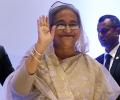
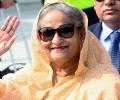
Deposed Bangladesh Prime Minister Sheikh Hasina has issued a strong warning against threats to ban her Awami League party, calling the demands "audacious" and accusing Nobel laureate Professor Muhammad Yunus of being a "fraud" and "corrupt" for his role in the current interim government. Hasina, who fled Bangladesh in August 2024 following a student-led uprising, claims Yunus assumed power through a "meticulous design" with funding from overseas and misled students and people. She asserts that her Awami League is the legitimate party, with a strong history of fighting for the people's rights, and accuses Yunus and his supporters of having no constitutional basis or people's mandate to rule the country.

Bangladesh on Friday deployed paramilitary border guards to beef up security after a top Islamist opposition leader was sentenced to death, sparking nationwide riots that killed at least 42 people.
The Anti-Discrimination Student Movement (SAD), which led protests against Bangladesh Prime Minister Sheikh Hasina, has launched itself as a political party called the National Citizen Party (NCP). The new party, which aims to 'dismantle constitutional autocracy' and establish a 'second republic,' has pledged to create a 'solely Bangladesh-oriented' political system, with no room for 'pro-India and pro-Pakistan politics.' The NCP's inaugural rally was attended by representatives of various political parties, including the Bangladesh Nationalist Party (BNP), Jamaat-e-Islami, and envoys from the Vatican and Pakistan.
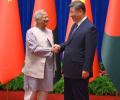
'It was the hostility of the Yunus regime that made India careful and wary of dealing with them.' 'They gradually backed off and lowered the noise, but the damage was done.' 'Their true colours had been exposed.'

The clashes broke out this morning when protesters attending a non-cooperation programme to demand the government's resignation faced opposition from the supporters of the Awami League, Chhatra League, and Jubo League activists.

Bangladeshis on Sunday began voting in the general elections expected to be won by Prime Minister Sheikh Hasina in the absence of the main Opposition Bangladesh Nationalist Party (BNP) which is boycotting it.

Jaishankar briefed the leaders of all parties about the situation in the violence-hit nation and the steps taken by the Indian government.

Noting that the Indo-Pak ties "remain tense", the US intelligence chief said India's engagement with Pakistan hinges on Islamabad's willingness to act against those responsible for the Pathankot terror attack.

He was convicted of running a militia torture cell, Al Badr, which carried out killings of several people.
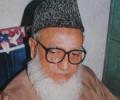
A 91-year-old top leader of the fundamentalist Jamaat-e-Islami was sentenced to 90 years in jail on Monday by a special Bangladeshi tribunal for masterminding atrocities during the 1971 war of independence against Pakistan.

Bangladesh on Sunday rolled out the red carpet for President Pranab Mukherjee who arrived in Dhaka on a three-day state visit to boost bilateral ties amidst a general strike called by Jamaat-e-Islami to protest conviction of its three top leaders for the 1971 war crimes.
Bangladesh police on Sunday arrested Jamaat-e-Islami leader and media doyen Mir Kashem Ali for his suspected role in perpetrating crimes against humanity during the country's 1971 liberation war.
At least three persons were killed in sporadic clashes in Bangladesh on Monday during a nationwide general strike called by fundamentalist Jamaat-e-Islami to protest their leaders' ongoing trial for 1971 war crimes.

Bangladesh on Sunday deployed troops in its north as a fresh wave of violence claimed 19 lives, taking the death toll to over 75, in clashes that have rocked the nation since the conviction of Islamist leaders for 1971 war crimes.
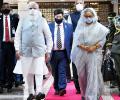
A senior leader of the hardline Jamaat-e-Islami group has been arrested in Bangladesh for allegedly instigating violence in March during Indian Prime Minister Narendra Modi's visit to the country, police said on Sunday.

Nizami now faces execution unless his case is reviewed by the court or he is granted clemency by the President.
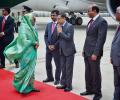
Sheikh Hasina, who was elected for a record fourth consecutive term and fifth overall term this year, was always admired by her supporters as "Iron Lady", before the dramatic development that abruptly ended her 15-year-rule in Bangladesh.
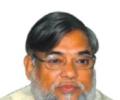
A top leader of the fundamentalist Jamaat-e-Islami party was sentenced to death on Wednesday by a special Bangladeshi tribunal for committing "crimes against humanity" during the country's 1971 liberation war.

Bangladesh's Supreme Court on Tuesday upheld the death sentence against the second highest ranking leader of the fundamentalist Jamaat-e-Islami for war crimes, including massacre of intelligentsia during the liberation war against Pakistan, paving the way for his execution.
 © 2026 Rediff.com - Advertise with us - Disclaimer - Privacy Policy - Sitemap - Feedback - About us - Terms of use - Grievances